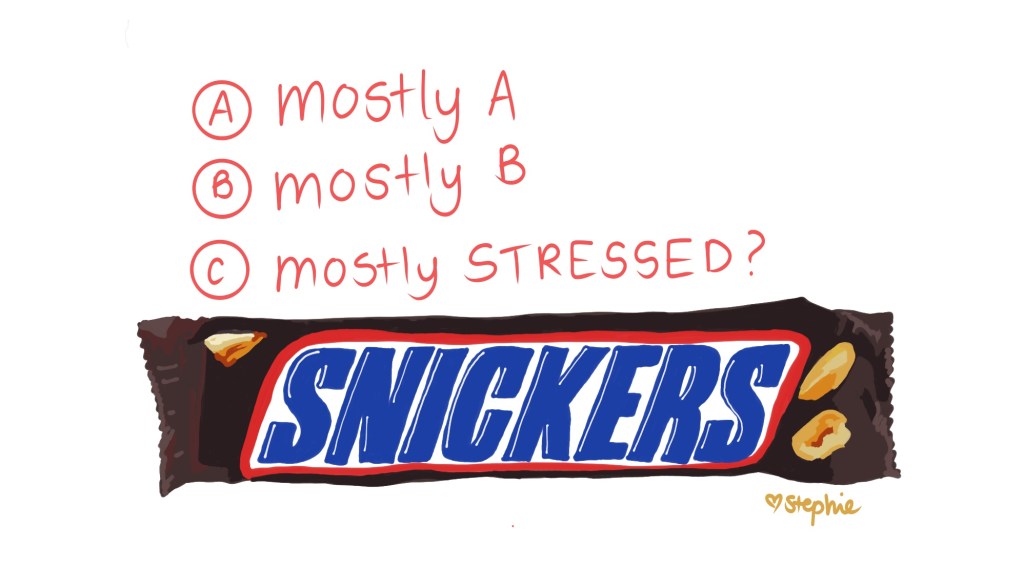
Alt title; you’re not you when you’re stressed.
I’m not going to lie to you, I love LOVE a personality test. I miss the days of opening Girlfriend or Dolly magazine and flicking through to the quiz. Completing it with a girlfriend and comparing your answers, asking; what does this reveal about me? Which PowerPuff girl are you? Who would be your celebrity boyfriend? I would look at the answers, ‘mostly a,’ ‘mostly b’ and hey, mostly manipulate my responses to get the final answer I wanted. Didn’t we all?
There are many more complicated personality tests out there and many simple ones, ranging from – are you an owl or a peacock? What’s your Myers Briggs? What enneagram are you? Recently my husband pointed out a meme to me which basically said “the enneagram is horoscopes for Christians,” haha everyone has a laugh. But there is a little bit (or a lot) of truth to that. At what point do we stop using this as a tool and it becomes the viewpoint in which we see ourselves and others? This is where we need to be cautious. Yes, take all the tests, isn’t it fun? But what do we do with that information? We are ideally using it as a tool, one of many ways, to identify our strengths, points of weakness and identify commonalities of how/why/when we work well or not well with others. It should not become the lens through which we see the world and ourselves. It should also not become an excuse for poor behaviour or poor relational building with others. When we think or utter phrases like, “well I’ll never get along with x because she’s an enneagram 3 and I’m an enneagram 1 and we are not compatible,” we are in trouble. When we think or act on thoughts like, “I cannot be expected to complete this task because I am an ESFP and it is not good for me,” we are in trouble. So what is it good for? The task of introspection is a helpful one; “the act of holding all our parts together before God requires that we grow in awareness of ourselves. It’s impossible to hold together what we don’t even know exists… The goal of self-examination is not navel-gazing. The goal of self-examination is freedom – freedom from destructive patterns, inner messages, and the ways we wrongly perceive things.”¹

By engaging with these tools we may be better able to identify our blindspots and our strengths. Not so we can only use our strengths, but so they can be developed. Not so we can simply be aware of our blindspots, but that we be mindful of them, not be further neglectful of them and to lean into healthy behaviours. Especially, “in the grip.”
What do I mean by “in the grip”? It’s a fun little idiom, isn’t it? It draws to mind being held under by a tight grip and certainly suggests a negative experience. It can be defined as ‘to be in a difficult or unpleasant situation,’² and further, ‘experiencing something unpleasant you have no control over.’³ Although this may seem obvious, we don’t always know we are in the grip until we have been in it too long. I was recently involved in some professional development which featured a side-note of understanding personality types. One which asked us to look up our 4 letter type with “in the grip” and respond to what came up. It linked to this article⁴ and my mind was blown. As I read through the list I was checking every box in reflecting on a time I thought was ‘mildly stressful.’
Holy pancakes. Was I really doing all of these things? Yes. Did I at all recognise that I was doing them or that they could potentially be linked to my personality type or that they suggested I was in far more stress than I perceived? No. Double-down on that no. This is another one of those beautiful life moments where hindsight teaches us a lesson we wish we learned at the time. Is this knowledge going to be the only lens through which I perceive myself and how I manage stress? Absolutely not. Is it helpful? Definitely.
I can tell at this point in time that I am in a better space, maybe occasionally stressed but definitely not in the grip. I know this, not just because my personality type tells me so, but because I have the headspace to contemplate this, to write and be creative, to think bigger.
What does that mean for you, dear reader? If you’re so inclined to do these personality tests, then do. But also look at the “in the grip” look at your triggers and identify them. Not for any other reason than to have a little warning bell which will sound for you when needed.
So you can become more aware of how you might be unintentionally treating others and how they might be perceiving you at that time.
So you can try to alter the situation you find yourself in.
So that you can enact some more helpful behaviours before you barrel down a path of self-destruction unawares.
Mostly, though, it is an invitation to learn more about who you are and learn from who you are under stress. To offer ourselves greater grace and kindness, to accept our own limitations and enlist the help we’ve identified we need.
You’re not you when you’re stressed and a Snickers won’t solve that. Trust me, I’ve done the leg work. This INTJ is aware that my very unhealthy habits are a sign of ‘in the grip’ and not a lack of self-control or a craving. Because when I’m well, I have zero desire to engage in those unhealthy habits. I have been able to create a warning bell in my mind, linking a poor behaviour to a symptom of something greater than simply accepting it for its surface value. This was a helpful exercise for me and I hope it is for you.
There are unfortunately many seasons in life where we find ourselves “in the grip” beyond our control and far longer than we want to be there. It is not always as simple as leaving a job when it is time to go. The support and help you need is going to be different to the support and help I need. The point is to identify it and enact it when it is needed.
I’ll leave you with this, dear reader, like Jacob,⁵ God is with us in the desolate places. In the grip, or not, you are not alone.
Go well,
Steph.
¹ Rich Villodas, The Deeply Formed Life: Five Transformative Values to Root Us in the Way of Jesus, Rich Villodas (United States: WaterBrook, 2020), pg. 106, 101.
² Macmillan Education Limited, “in the grip,” accessed April 20, 2023, https://www.macmillandictionary.com/dictionary/british/be-in-the-grip-of-something#:~:text=DEFINITIONS1,in%20the%20grip%20of%20winter.
³ Cambridge University Press & Assessment 2023, “in the grip,” accessed April 20, 2013, https://dictionary.cambridge.org/dictionary/english/be-in-the-grip-of
⁴ Susan Storm, “What you’re like during Grip Stress, based on your Myers-Briggs Personality Type,” in Psychology Junkie, 4 March 2021, https://www.psychologyjunkie.com/what-youre-like-during-grip-stress-based-on-your-myers-briggs-personality-type/
⁵ see: Genesis 10:10-17. Also be encouraged by; Isaiah 41:10 and Psalm 46:1-3 as examples of many, many verses which speak of God being present in our desolate place, our difficulty and our trouble.
 letters and lattes
Leave a comment