What does the shy girl want?
But to be loved from the offset
To be invited
And made welcome
To feel seen and known and valued
Without doing a dance
Of performance first
A dance of striving
Which screams
Love me for THIS —
And becomes the label we wear
For eternity.
And really
Shouldn’t this be what we all want?
To be loved
    Known
    Seen
Without the dance.
Imagine all the time saved
From dress rehearsals
In front of the mirror
And practicing our pretend postures
When really
We could have just finished the book
We wanted to read
In the first place.
What does the snide girl want?
As she throws her sneer
Offensively around the room
But control
And protection
And maybe not to have to hide
In the box we’ve put her in.
Because it’s really hard
To define yourself
Once someone has done it for you.
But it might be easier
To be snide, sharp, spiteful
Than just simply
Your weird original self.
In those early years
The attributes of quirky and fun
Are embraced so freely
But we grow and conform
And suddenly ‘weird’
Is exorcised and exiled
And who would want to be alone
When your friends
Parade their faux-maturity
And you see there’s room
In the hierarchy
For a little apathy
And the right amount of sass,
Which is sometimes overdone,
As you try to find your way to
An equilibrium
Of control and acceptance.
When really, you know, you know
You are no longer accepted
And all you want to do
Is write a letter of gratitude
To your cat
Because she’s the only one
Who loves YOU —
The weird, weird
True you.
Girls, we need to do better by you.
And for you
And for ourselves.

-fin-
It would be easier to leave the snide girl in her snide box, extending only judgement and dismissing her as being anything else but snide. It is easier to leave people in their boxes, with their labels firmly attached. But we have lost much of the richness of life by only pursuing what is easy. There is a level of romanticising the snide girl here, in portraying her as choosing to be snide as an escape from being typecast as the ‘weird girl,’ but there is also some truth. It is not the whole truth, but it is a start in attempting to understand someone else’s perspective and how they have been limited by being placed in a box.
Also, shy girls, we need to do better by you. You are the golden delight, the crunchy crumb on our gaytime, you are full of wisdom and splendour and I just want the whole world to know how glorious you are. Even though you a thousand percent hate the attention. Sorry.
If you wondered what sort of teacher I am, perhaps what you have read so far in this post has given you a clue. We could all do more to hold others with greater empathy and try our best to understand more than just the surface-level behaviour of another person; but also their motivations, their intent, who they are as a whole. And how perhaps we have come to see only a shade of them and acknowledge that we can do more, can do better, to see them in their fullness.
How else do we get out of these boxes?
How else do we encourage our daughters to love themselves and the beautiful way they express who they are?
How else do we encourage ourselves to not be subjected to the labels and boxes we’ve been shackled with?
I think of all the times I have been placed in a box. Either lovingly, with intended kindness or from judgement and those times I placed MYSELF in the box; mostly out of fear. Fear of being left out or left behind. The parts of myself I had to scrape away or cut off to fit in the box — where did they go? Did they just float off waiting to be discovered once more or did they disappear into the ether forever? Who would we be if these pieces were still attached? Would we be braver, bolder, less lost when other horizons, like motherhood or middle age, come to test our identities once more?
We allow these prunings to take place in the name of “growing up” but what if we did better at embracing each other and encouraging our girls in their fullness? What if we didn’t say “you’re too much / too loud / too sensitive / too quiet” or feel the need to pick apart the hobbies and interests of others simply because they are of no interest to us.
“That would have required thinking outside the box, and if high school had taught me anything, it was that you stay in your box.”¹
Tabitha Carvan, p.56
As much as This is not a book about Benedict Cumberbatch is very much a book about Benedict Cumberbatch, it also explores this pruning and what we have lost. As teenagers we grow up to believe “we must stay in our box” and view ourselves “through the filter of how others see us,” watching others let go of their hobbies, interests and “obsessions in the name of maturity.”¹ Instead of embracing and “protecting all the little weirds that make up who you (we) are.”² I love this sentiment from Jenny Slate’s memoir-slash-fictional-short-stories;
“I am wild and I want to be that and to belong to the greater group and have everyone know that my wildness is nothing but a bit of my colors and has nothing to do with whether or not I can be trusted.”²
Jenny Slate, p.169
Don’t we all — the desire to both be completely ourselves and completely welcome, to have community and the safety of our people who accept our wildness, our weirdness in all our colours and complexity.
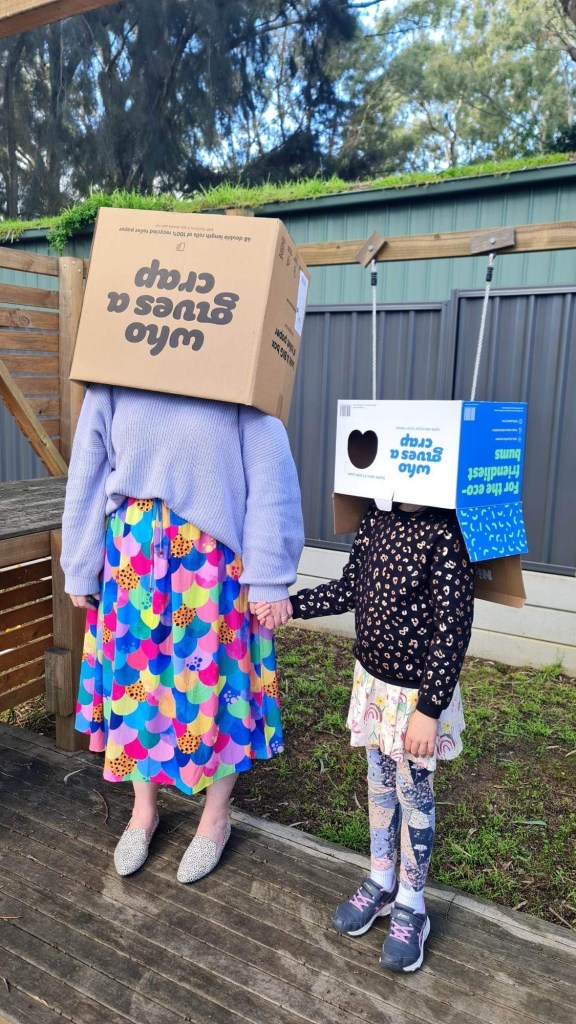
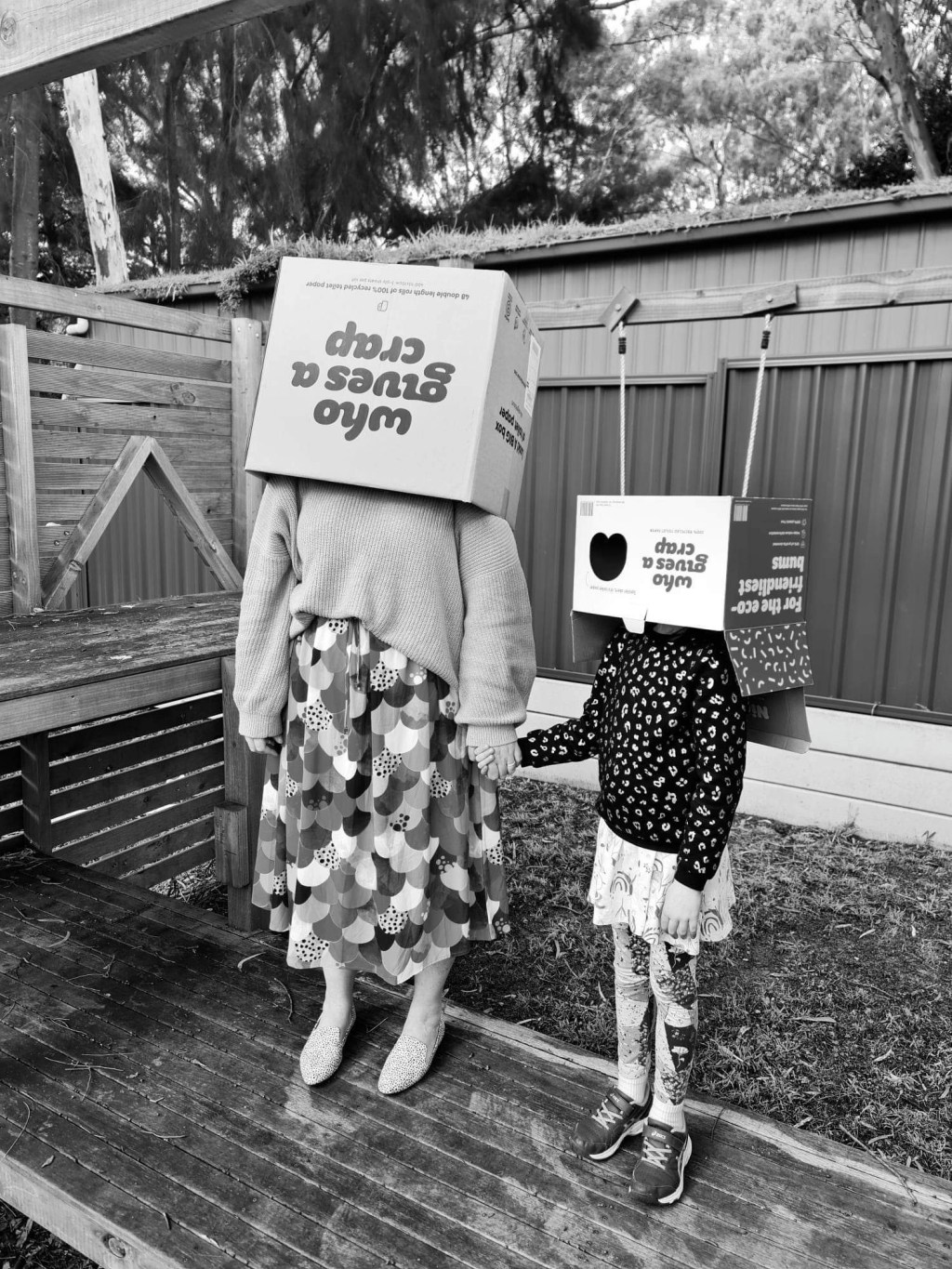
After I had drafted this poem initially, I envisioned my daughter and I standing next to each other with boxes on our heads to not-so-subtly represent the metaphor of girls being in boxes. I was like, and what if we had different outfits and represent the different versions of ourselves we are typecast as and subjected to? As it was, I had to bribe her with iPad time for these photos so outfit changes were not going to fly. She is pretty happy to go along with my whimsy (and I hers), but the initial commitment can be a challenge. The boxes we had happen to say “who gives a crap?”³ Part of me thought, I can edit that out so they are blank. But the other part thought, YES! Who does give a crap? Better yet, they should say; why should we give a crap?
Tall girl, weird girl, shy girl, snide girl. Each iteration of us, are all the same in our longing to know who we are and not be defined in such one-dimensional ways.
Tip for the day – consider who you have put in a box and try to understand who they are outside of it. Even if you need to romanticise it a little. Give yourselves and others permission to be all of who they are without the need to label them or box them in. Let us each be bolder in removing the boxes and creating a safe place for others to be themselves.
Girls, we need to do better by you.
And for you
And for ourselves.
Go well
Steph
PS: embrace your weird, it’ll be ok x
¹ Tabitha Carvan, This is not a book about Benedict Cumberbatch: the joy of loving something-anything-like your life depends on it (Australia: HarperCollins, 2022), p. 56-57
² Jenny Slate, Little Weirds (Great Britain: Fleet, 2020), p.169, 216.
³ This is not an ad, I promise. If you want great toilet paper though, go on, have a browse: https://au.whogivesacrap.org/
 letters and lattes
Leave a comment