Reframing Resilience – on developing a posture of resilience.
I once had someone ask me about my resilience, their comment was something along the lines of, “you seem like a very resilient person, how do you learn that? What would your insight or advice be for developing resilience?” (This is a terrible paraphrase of their question) My response, embarrassingly enough was, “childhood trauma.” HAHA. I literally laughed awkwardly. To be honest, I hadn’t really thought about it. I was very much aware that my character had been shaped deeply by (please do air quotes as you read this): “childhood trauma” but I soldiered on, because that’s what we do, right? The unfolding conversation made it clear from their perspective: no. Not everyone soldiers on and why won’t you tell me your secret? The thought I walked away from that conversation with was, Steph, maybe you should think about this more deeply.
Fast forward a few years and a pandemic and a surplus of helicopter parenting and a generation of entitled children (sweeping generalisations here) and we find ourselves in a crisis of resilience. Like many schools, we were feeling this deeply and sought to work with resources from a third party to assist us in educating our students about resilience. To help them develop resilience, for them to grapple with the big things of the world and be willing to try and fail and make mistakes and not let that be the end. The resources we’ve engaged with are through ‘The Resilience Project,’¹ maybe you’ve heard of this. And there are many worthwhile aspects to this, especially around the development of emotional literacy for teenagers. Oh boy. The core aspects of this are what they call “GEM,” gratitude, empathy and mindfulness. Then they attach + emotional literacy. These are great values. Yes, we should all develop empathy, practice gratitude and mindfulness and these are helpful tools to develop our resilience. But, if I’m honest, I find them lacking. There are two reasons I find it lacking, allow me to explain.
One, and I think you’ll get on board with this, it isn’t shaking up the entitled self-centred perspective that needs to be shaken up. It is not the earth shattering eye-opening worldview changing radicalisation these young people need. They need to have a Dr. Strange moment of clarity where the Ancient One looks him in the eye and emphatically states; “it is not about you.”² But how do you get there? How, when for some people their entire lives have been completely and utterly about them. Whatever they want, need, demand, they receive. Without exceptions. Where every difficulty is swept away before they have to consider how they could possibly navigate it. They haven’t had to. They learn about empathy but they don’t practice it, it doesn’t change them, they have not yet learned the secret. And maybe they won’t. There are plenty (PLENTY!) of adults who are perfectly completely wonderfully happy doing whatever they want with no consideration of how it impacts others.
Two, and I’m fully aware that I might lose you on this one, but try your best to stay with me. If we learn about gratitude, empathy and mindfulness and we realize it is not about us – what is it about? This is lacking because we have removed God from the equation. We have secularized and watered down Biblical messages and themes to attempt to assist our worrying world into a place of calm and resilience. We have so many ‘experts’ and podcasters who have researched mental health and resilience and have created a wonderful list of guidelines for life, many of which are INCREDIBLY Biblical, but minus God. Our post-Christian culture is so unchurched we accept these without question or recognition of their clearly Christian undertones. A friend of mine was speaking of a podcast she listened to that did exactly that. I cannot remember for the life of me who it was or what podcast they were referencing. A few days after writing this I read the following,
“Remember what I said about finding a meaningful life? I wrote it down, but now I can recite it: Devote yourself to loving others, devote yourself to your community around you, and devote yourself to creating something that gives you purpose and meaning.”³
Morrie Schwartz
Mitch Albom, p.126
This is from the ‘international bestseller’ Tuesdays with Morrie which for many shaped their personal values and gave them lessons to lead their lives. Morrie identified himself as agnostic, but I’m sure you can hear the Biblical messages in his life creed here. What’s missing? God. Loving God and pursuing God’s purpose, like Morrie, we have taken God from the equation and made ourselves the idol of life’s purpose.
If only we could see the irony. Yet, if we looked to the Bible, we would see gratitude in the Lord’s Prayer, in how we were taught to pray by beginning with thanksgiving. We can see Jesus as an absolute role model of empathy, “compassion” is central to his miracles and his relating to others. Meditation is a deeply Christian practice with Jewish origins, it can be found in scriptures, meditate on the Psalms, on the world of God, ask a Monk about it! Ok, I’m getting carried away.
The definition of resilience I resonate with is this:
Realism + Hope = Resilience⁴
We can give our young people as many tools as we like to grapple with the world and help to develop their resilience, but if we do not point to hope, we will fall short.
If we only give them hope and no foundation of understanding this in the light of their reality, we will fall short.
This isn’t just a message for young people, it is a message for all of us. How do we develop resilience? We need Realism (a realistic picture of who we are, our world, the context in which we find ourselves, etc) and we need Hope (hope for the future, a better time ahead, hope that this too shall pass and the ultimate hope we find in Jesus).
Perhaps if I had read this before I was asked about my resilience I might have had a better answer.
Let me try now.
I have developed resilience through realism + hope. I do not walk through the world with rose-coloured glasses, I was not brought up with a sense of entitlement, but one where I was held accountable for my actions and I was very aware of who I was and what I had to grapple with. But, but but but, I had hope. The real answer to my friend’s question about resilience would be faith: I was fully aware as a young child of God’s presence with me and love for me – that is my foundation. So it didn’t matter if my whole world was turned upside down (and it was), I had what I needed. My gaze was fixed, not on the issues of my circumstance, but on the God of hope. My eyes are up, not at my feet but at my God, the God of hope who gives me joy and peace.⁵ That. That’s my resilience. This is my baseline and has allowed me to grow and mature, and grow and mature in faith, to be a person known to bring calm and to be a non-anxious presence for others in times of difficulty and uncertainty. I resonate strongly with the evidence that “the roots of faithfulness often sink deeper in anxious, unsettled times. Faith can grow even – and sometimes especially – in the darkest of places.”⁶ Through this faith and testimony of the faithfulness of God, there is abundant hope not just for this particular ‘darkest of places’ but for all those to come.
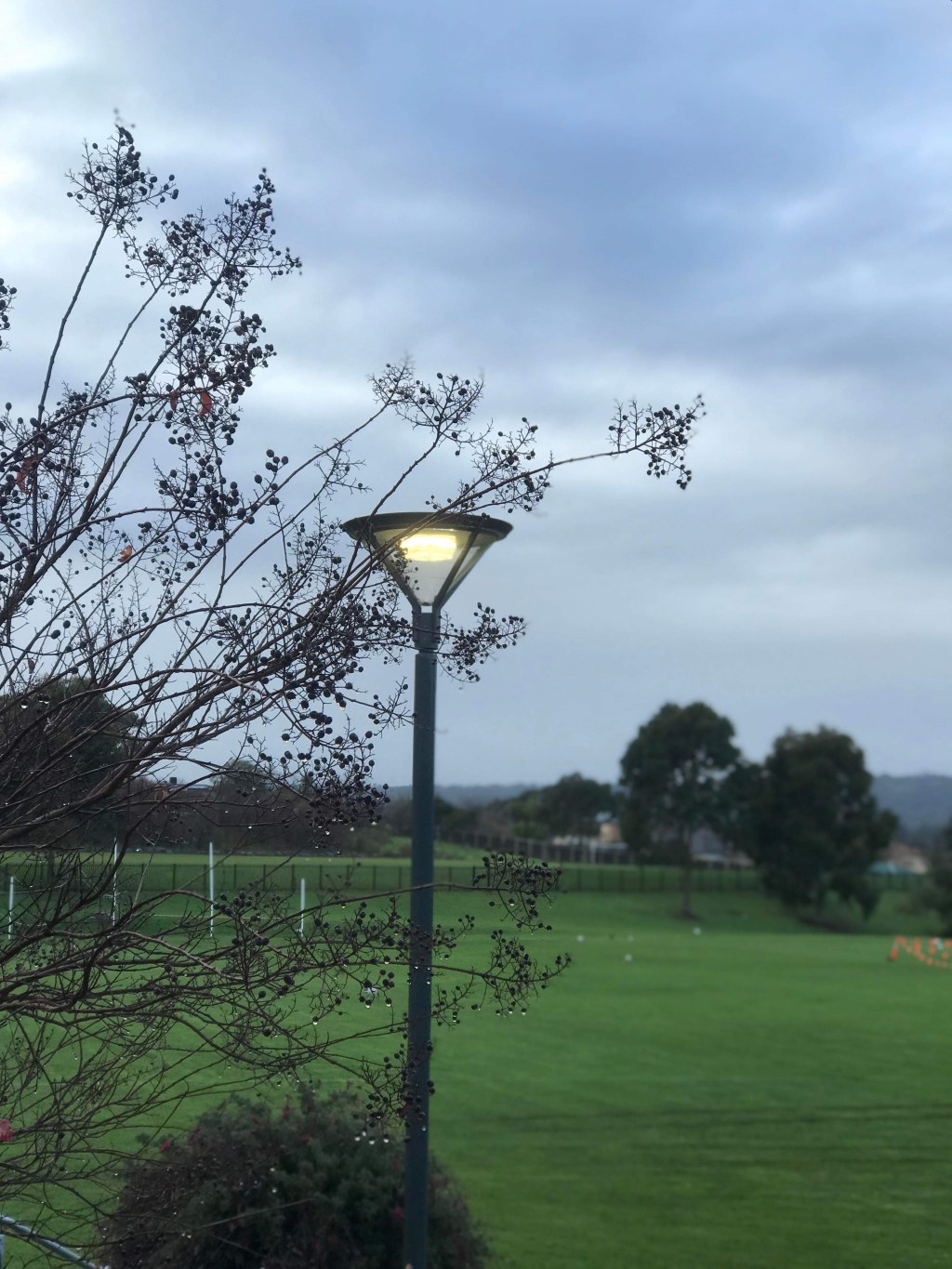
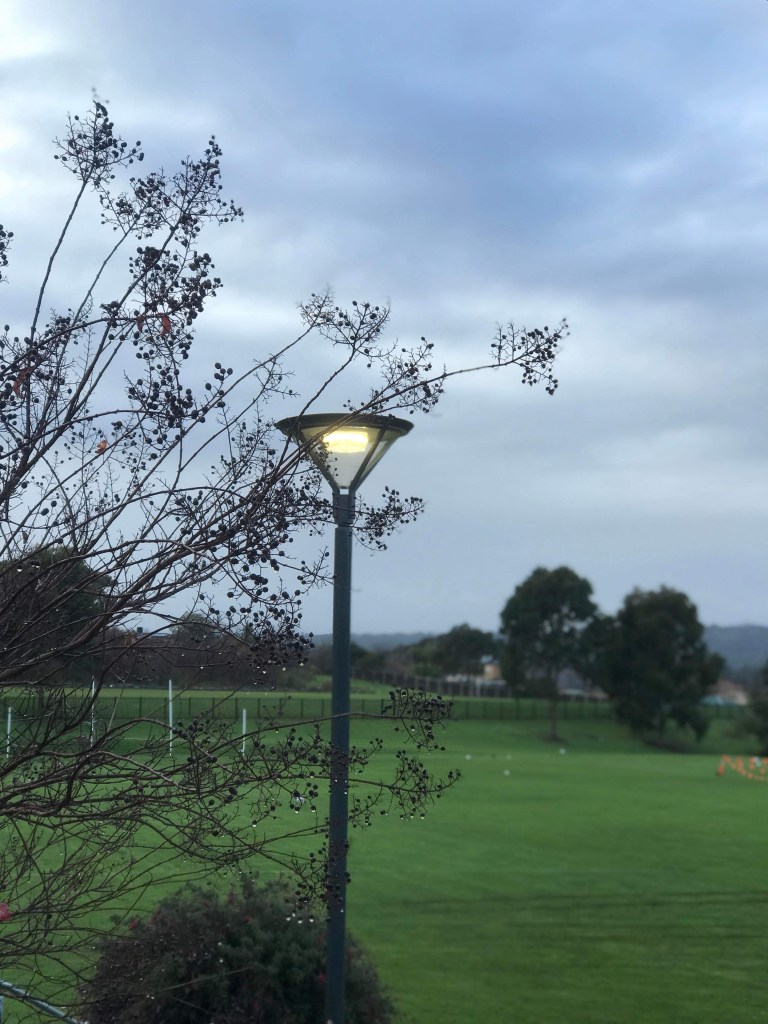
On a very cold morning, the lamp is aglow.
A number of years ago our school undertook a building project which included landscaping onto the oval. Part of the new addition were a series of street lamps on the border of the garden and the oval, which has a beautiful London-old-timey aesthetic. During winter the morning fog is all encompassing, swallowing the oval whole. I especially love these foggy mornings, when the glow of the lamp is bright, illuminating the fog, which try as it might, is unable to dim the glow. Isn’t this what hope is? A light which refuses to dim, regardless of the circumstance, which will not allow the fog to swallow it whole. Is this not also resilience? To blaze on, not in ignorance or avoidance of the fog. But because your gaze is set elsewhere.
Gratitude, empathy and mindfulness are great, but it is hard to develop resilience if we do not know who we are. It is hard to develop resilience if we do not have hope. So let us do our best to fill in the gaps of where other resources lack, to lead by example, to be willing to share more of our story and how we have developed the attributes that will help others in the journey ahead.
⁴ David Kinnaman & Mark Matlock, Faith For Exiles: 5 Ways for a New Generation to Follow Jesus in Digital Babylon (Grand Rapids, MI, USA: Baker Books, 2019), p.214.
⁵ Romans 15:13 (NIV): “May the God of hope fill you with all joy and peace as you trust in him, so that you may overflow with hope by the power of the Holy Spirit.”
And also,
Romans 5:1-5 (NIV): “Therefore, since we have been justified through faith, we have peace with God through our Lord Jesus Christ, through whom we have gained access by faith into this grace in which we now stand. And we boast in the hope of the glory of God. Not only so, but we also glory in our sufferings, because we know that suffering produces perseverance; perseverance, character; and character, hope. And hope does not put us to shame, because God’s love has been poured into our hearts through the Holy Spirit, who has been given to us.
⁶ David Kinnaman & Mark Matlock, Faith For Exiles: 5 Ways for a New Generation to Follow Jesus in Digital Babylon (Grand Rapids, MI, USA: Baker Books, 2019), p.16.
 letters and lattes
Leave a comment