I’m going to be ruthlessly (and disappointingly) upfront here – this post does not have an ending. It’s like that novel you picked up to read whose opening line declares “this story does not have a happy ending” or goes even further by foretelling the protagonist’s death. And despite your commitment, at purchasing or borrowing this book with the engrossing cover, you find yourself giving pause. Do I want to read this? Am I prepared for an unhappy ending? Will I be satisfied? I don’t know, dear reader, but I do hope you will take this journey with me. And please – would you let me know?
Secrets have a certain weight to them, don’t they? They are shackles bound not to your ankles, but your soul, masking a locked box of your identity. The ‘skeleton in the closet’ comes with the suggestion of possession. It is a choice to create or steal or mold a skeleton and then choose to purposely shove it in your closet. It is yours. You chose the skeleton and are now choosing not to share it. But the shackles, these were placed there by someone else. Yet you carry the weight. It is like this with secrets. Some we mold and hide all on our own, and others are given to us and we bear the weight. I am reminded of a very well-known quote on this, I like the retelling of it here:
“This is heavy, so share the load… there are a thousand slogans and mottos in AA, and one of them is you’re only as sick as your secrets…. It was a quote from Benjamin Franklin: three may keep a secret, if two of them are dead.”
Fairy Tale, p.175¹
I like this retelling because there are multiple perspectives at play. It is acknowledging that sharing our secrets lightens our load, secrets themselves can poison us but also by sharing our secret and daring to trust another soul with it, means the secret no longer belongs to us and we have lost control of it.
The question I would like answered is; when does a secret end? Have you ever been shackled with information or experience that at one point in time was given the direction of secrecy… indefinitely. Now some secrets we know are limited. I know, for example, when the official pregnancy announcement comes on social media (or elsewhere) I no longer have to feign ignorance, this ‘secret’ has a definitive end point. But not all secrets are so clearly defined. I’m aware that I’m using the language of ‘secrets’ which might be alarming and I don’t mean it to be so. For many of us we have lived through events and experiences which have been deeply impactful, where we have been gravely affected but also not the central character. What permission do we have to share someone else’s experience which has affected us so? And even more so, if at the time we were asked for our discretion. And I’m not talking about Trauma with a capital T or abuse and I in no way want to suggest that survivors of such need to continue on in their secrecy or question their ability to own their story, but for many of us, this question feels unresolved.
In the wise words of Marcus;²
“It* happens, and I wish it didn’t, but that’s life, isn’t it? There’s nothing I can do about it.”
*whatever “it” is for you. Sometimes there is nothing we can do about it, sometimes there is much that can be done. The “it” itself can be very isolating, especially when we feel we don’t have permission to share it.
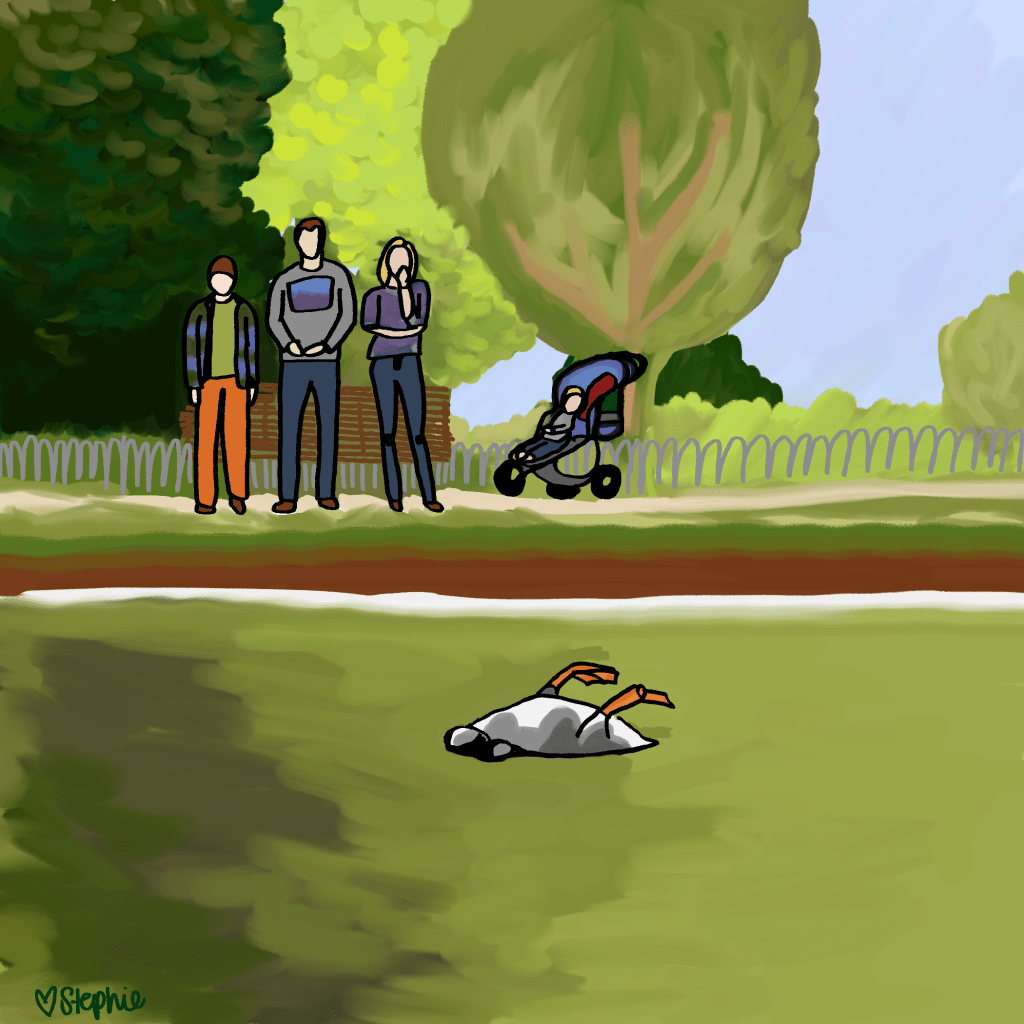
We cannot avoid the complexity of our lives and how they are intertwined with others. Even Hugh Grant (well, his character, Will Freeman)² had to accept that no man is an island!³ For many people they can easily ignore this or plead ignorance as they broadcast their experiences, unaware and unaffected by the damage it may create and how other pivotal players have been cast in this retelling. I mean, that’s partly why defamation lawsuits are a thing, right? The other end of the scale are those of us who are so cautious of the potential damage we could cause for another person by just unleashing a shackle that we do not do so. We are aware, too, of the other bystanders who are part of our story or the story, another member of the secret-shackle-club who do not own this story for themselves. We are aware that our retelling and our limited perspective may cause them further harm or pain or simply portray them in a less than flattering light.
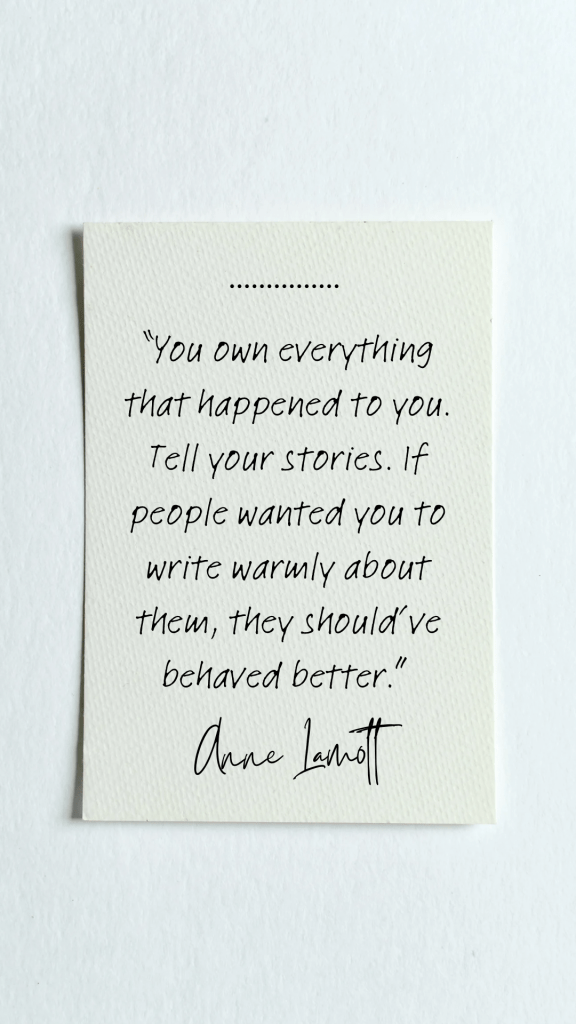
Anne Lamott’s⁴ words here give me some courage;
However, what happens next? The fallout, I’m sure, will inevitably remain.
How do we get permission to tell our story? Do we say stuff it, cast the shackles aside and let the chips fall where they may? Even if great damage is caused? Is this treating others well? Or do we hold onto it forever and allow the weight to consume us.
For me, I have slowly revealed these parts where I have felt safe to do so. Taking the shackles off for a moment and allowing my feet the ability to move freely. I have had counseling and great friends and been through a process of acceptance and forgiveness. Prayer has been my greatest refuge. Part of the reason we bear the weight is because we can. I continue to carry this load because I can endure it. I can bear the weight. And the main reason I can, is because I don’t endure it alone, I hand it over.⁵ Part of the reason I remain shackled is simply this: grace. I hadn’t really put that together until singing grace upon grace,⁶ in collective worship and it clicked. I have received grace and I can extend it to someone else who is in need of it. I’m not shackled by their strengths, but by their weaknesses and failings and the best gift I can possibly give them (aside from love and forgiveness) is grace.
But, dear reader, I still do not feel like I own this story. I do not feel like I can publically state a ‘secret’ which in reality has not been a secret for many, many years, yet carries the weight as though it is. I hope to one day have the freedom to throw it around as an anecdote at a dinner party or offer it in loving advice to a new friend. Whereby it will be said without fear and received in grace and good humour. (My humour is very dry and dark so this may not be appropriate).
These parts are also such a significant part of who I am, of my testimony and the grace of God at work in my life which I would like to declare more strongly. And yet they are hidden under many, many layers I do not own.
And yet.
Go well
Steph
¹ Stephen King, Fairy Tale (Great Britain: Hodder & Stoughton, 2022), p.175.
² About a Boy (2002) Universal Pictures.
³ If you are yet to watch About a Boy (put it on your list) the central theme is about our need for connection with others and that we cannot (should not) do life in isolation. The main characters reference the line “no man is an island” attributing it to Jon Bon Jovi. Bon Jovi used the idiom in his song Santa Fe (1990) however it was originally written by John Donne in 1624. You read that right folks – 1624. It is from his Meditation 17 with some referencing it as a sermon. I started off fact-checking this reference and naturally did a deep dive into John Donne’s life and work, finding it beautiful, reflective and relevant. If you too would like to know more, I would encourage you to start here: https://www.poetryfoundation.org/poets/john-donne
⁴ Anne Lamott, Bird by Bird: Some Instructions on Writing and Life (1995).
⁵ 2 Corinthians 12:7-10 (MSG) see also my poem Done which can be found on Instagram @lettersxlattes
⁶ On Repeat (2021) by Hillsong UNITED. – Listen/watch here: https://youtu.be/4Be4uvqhiS0
 letters and lattes
Leave a comment